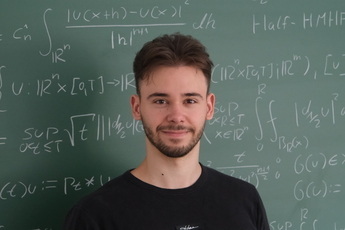
Kilian Koch
Doctoral Researcher in Mathematics
Chair of Applied Analysis · RWTH Aachen University
I work on gradient flows in geometric analysis, in particular well-posedness and singular behaviour of half-harmonic map heat flows. I am a doctoral researcher in CRC 1481 Sparsity and Singular Structures at RWTH Aachen University.
More about my research
I work on gradient flows in geometric analysis, in particular well-posedness and singular behaviour of half-harmonic map heat flows. I am a doctoral researcher in CRC 1481 Sparsity and Singular Structures at RWTH Aachen University.
0009-0008-4358-9245 RWTH profile arXiv GitHub LinkedIn koch@math1.rwth-aachen.de
Publications
-
Thresholding Scheme for the Half-Harmonic Map Heat FlowarXiv (2026-09-22) preprint
Show Abstract
We propose a thresholding scheme for the half-harmonic map heat flow from the flat torus $\mathbb{T}^d$ into the unit sphere $\mathbb{S}^m$ in $\mathbb{R}^{m+1}$, whose iterates are given by convolution with the Poisson kernel, replacing the Gaussian kernel of the classical Merriman-Bence-Osher algorithm, and pointwise normalization. We prove that the piecewise constant interpolants subconverge to a weak solution of the half-harmonic maps heat flow that attains the initial map strongly in the energy space and satisfies the energy-dissipation inequality. For a spectrally truncated variant, convergence holds under a condition on the step size. A key ingredient is the derivation of the precise energy-dissipation identity directly from a refined within-step estimate, without resorting to De Giorgi interpolation typically used in the minimizing movement framework. This provides a direct way to recover the appropriate energy-dissipation property in the limit and, in turn, enables weak-strong uniqueness: every energy-dissipating weak solution coincides with the strong solution whenever the latter exists. -
Well-posedness of half-harmonic map heat flows for rough initial dataarXiv (2025-04-09) preprint
Show Abstract
We adopt the Koch-Tataru theory for the Navier-Stokes equations, based on Carleson measure estimates, to develop a scaling-critical low-regularity framework for half-harmonic map heat flows. This nonlocal variant of the harmonic map heat flow has been studied recently in connection with free boundary minimal surfaces. We introduce a new class of initial data for the flow, broader than the conventional energy or Sobolev spaces considered in previous work, for which we establish existence, uniqueness, and continuous dependence. The class particularly includes homogeneous initial data that give rise to self-similar expanders.
Talks
-
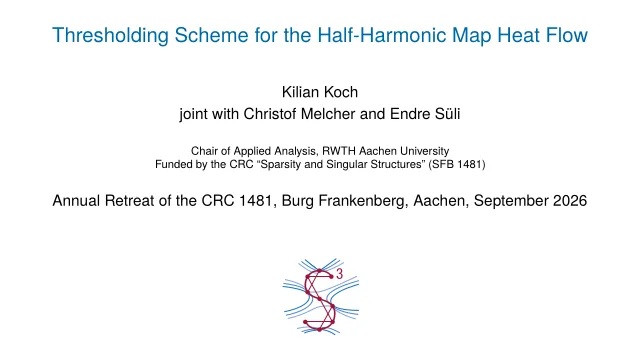 Thresholding Scheme for the Half-Harmonic Map Heat FlowAnnual Retreat of the CRC 1481 “Sparsity and Singular Structures”, Burg Frankenberg, Aachen · 30 September 2026Slides (PDF) Event page
Show Abstract
We propose a thresholding scheme for the half-harmonic map heat flow from the flat torus 𝕋^d into the unit sphere 𝕊^m in ℝ^(m+1), whose iterates are given by convolution with the Poisson kernel, replacing the Gaussian kernel of the classical Merriman-Bence-Osher algorithm, and pointwise normalization. We prove that the piecewise constant interpolants subconverge to a weak solution of the half-harmonic maps heat flow that attains the initial map strongly in the energy space and satisfies the energy-dissipation inequality. For a spectrally truncated variant, convergence holds under a condition on the step size. A key ingredient is the derivation of the precise energy-dissipation identity directly from a refined within-step estimate, without resorting to De Giorgi interpolation typically used in the minimizing movement framework. This provides a direct way to recover the appropriate energy-dissipation property in the limit and, in turn, enables weak-strong uniqueness: every energy-dissipating weak solution coincides with the strong solution whenever the latter exists. -
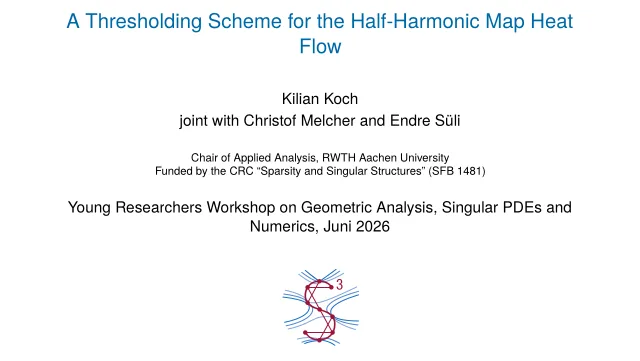 Thresholding Scheme for the Half-Harmonic Map Heat FlowYoung Researchers Workshop on Geometric Analysis, Singular PDEs and Numerics, RWTH Aachen University · 1 June 2026Slides (PDF) Event page
Show Abstract
We study the half-harmonic map heat flow, the gradient flow of the half-Dirichlet energy for sphere-valued maps on the torus. Motivated by the thresholding algorithm of Laux and Yip for mean curvature flow, we replace the classical Gaussian kernel by the Poisson kernel, the semigroup kernel associated to the half-Laplacian, and alternate convolution with pointwise projection onto the sphere. We prove that the resulting iterates converge, along a subsequence, to a weak solution of the flow attaining the initial data in H^1/2 and satisfying an energy inequality. We also consider a truncated variant of the scheme, where the Poisson kernel is projected onto the first N Fourier modes. Here convergence holds under the condition that hN − d(d+1) log(1/h) → ∞, meaning N must grow slightly faster than log(1/h)/h as h → 0. This truncated version is intended as a first step toward a fully implementable numerical method. As a complement, we establish weak-strong uniqueness: a weak solution satisfying the energy inequality must coincide with any strong solution sharing the same initial data, showing in particular that the scheme converges to the strong solution whenever one exists. -
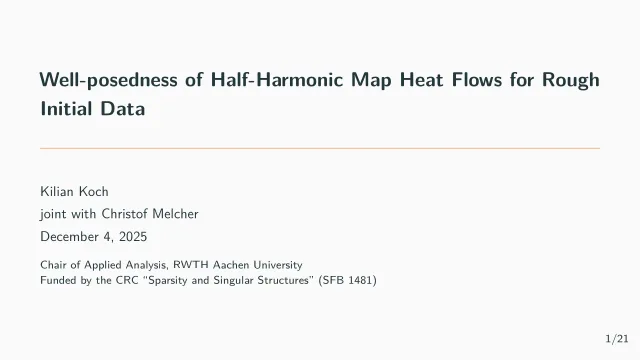 Well-posedness of Half-Harmonic Map Heat Flows for Rough Initial DataApplied Analysis Seminar (invited talk), Heidelberg University, Germany · 4 December 2025Slides (PDF) Event page
Show Abstract
We adopt the Koch–Tataru theory for the Navier–Stokes equations, based on Carleson measure estimates, to develop a scaling-critical low-regularity framework for half-harmonic map heat flows. This nonlocal variant of the harmonic map heat flow has been studied recently in connection with free boundary minimal surfaces. We introduce a new class of initial data for the flow, broader than the conventional energy or Sobolev spaces considered in previous work, for which we establish existence, uniqueness, and continuous dependence. The class particularly includes homogeneous initial data that give rise to self-similar expanders.
Organized Events
-
Young Researchers Workshop on Geometric Analysis, Singular PDEs and Numerics OrganizerJoint workshop of CRC 1481, EDDy and IntComSin (FAU Erlangen-Nürnberg / University of Regensburg), RWTH Aachen University · 1 June 2026 – 3 June 2026Event page
Research Project & Funding

Project C01: Singularity formation in dissipative harmonic flows
My position is funded by the German Research Foundation (DFG) through CRC 1481 Sparsity and Singular Structures (project no. 442047500), project C01, since October 2024.